
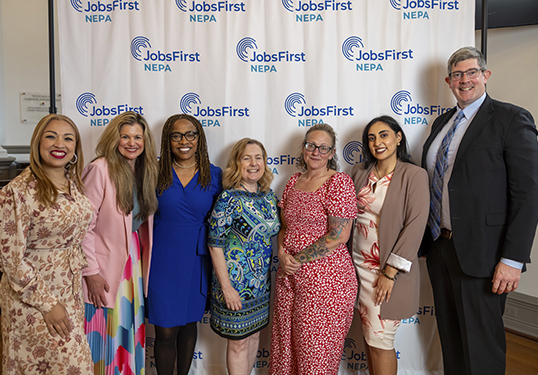
What does Northeastern Pennsylvania look like when partners across industry, education, community, policy, and philanthropy align around shared regional workforce priorities? Envision a coordinated cohesive, and integrated ecosystem that supports work, education, and community to advance long-term economic mobility. On April 28th more than 65 community partners and institutions from across the ecosystem gathered at The Century Club in Scranton to commemorate the launch of JobsFirst NEPA, the region’s first neutral workforce intermediary, dedicated to creating and advancing solutions that break down barriers and transform the systems supporting young adults and their communities.
Supported by key partners and deep data, the launch celebrated years of planning, researching and mapping while driving forward a shared vision to collectively tackle the region’s urgent workforce needs.
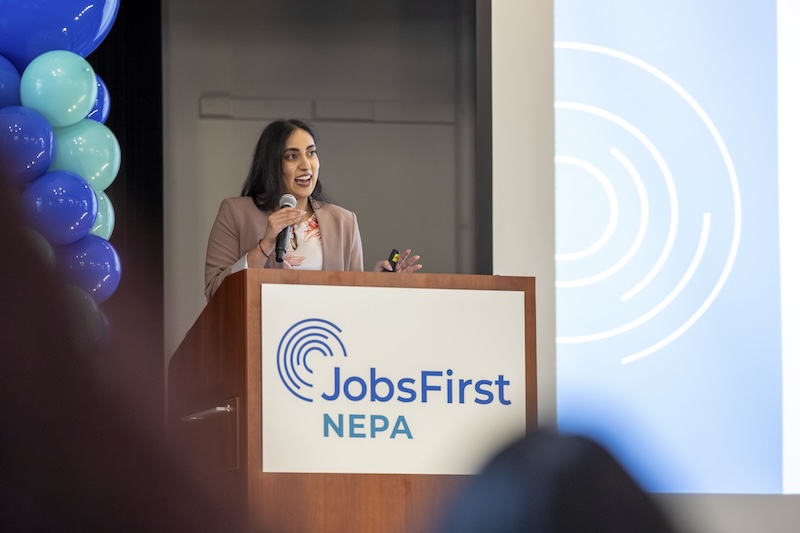
The launch opened with remarks from Shanie Mohamed, Founding Executive Director, JobsFirst NEPA, who reflected on the journey to launch: “JobsFirst NEPA is the result of years of regional learning to inform the need for this infrastructure. From the local community partners, anchors, and institutions to the fellows and national partners who put months of effort toward mapping the landscape behind the scenes – today is truly a celebration of what we are about to build together for Northeastern Pennsylvania.” She shared her experience in the NEPA Workforce Leadership Academy, led by the Scranton Area Community Foundation and the Aspen Institute in 2023, which planted the seed of intermediary establishment in the region. Participation in the Aspen fellowship, coupled with a six-year career in economic development and NEPA Thrives steering committee service, ultimately led Mohamed to the regional leadership role she now holds – and it warranted sentiments of gratitude for the partners who made it all possible.
Creating the Conditions for Success
Laura Ducceschi, President and CEO of the Scranton Area Community Foundation (SACF), provided a powerful look at the “why” behind this launch, tracing the journey from local inquiry to regional action. She reflected on a central question that sparked the initiative: “Why, in a region full of committed leaders and educators, do we still struggle to align around workforce solutions that work for everyone?”
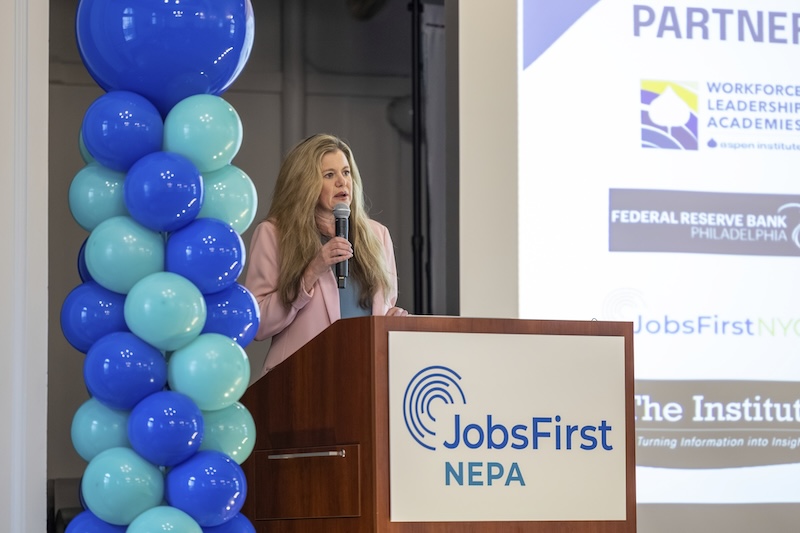
While Northeastern Pennsylvania has never lacked effort or dedicated organizations, it previously missed the sustained structure to hold those efforts together. Ducceschi highlighted several key milestones that informed the creation of JobsFirst NEPA:
- The Aspen Institute’s Workforce Leadership Academy: A pivotal experience that allowed regional leaders to step back and recognize that the system’s challenges were structural, not just programmatic.
- NEPA Thrives & Anchors for Equity: Direct work with employers and partners that revealed a disconnect between training providers, schools, and community organizations.
- The Missing Link – Moving outside of Moments: The realization that no single organization could solve these systemic gaps alone. It requires moving from “moments” of alignment to a permanent, regional infrastructure – a role only a neutral workforce intermediary can fill.
“JobsFirst NEPA is not just another initiative. It is the infrastructure we have been building toward – a neutral, regional workforce intermediary that aligns partners across industry, education, community, and policy; advances sector-based strategies in high-demand industries like healthcare; and builds clear, connected pathways for individuals, especially those who have historically been left out.”
Laura Ducceschi, President and CEO of the Scranton Area Community Foundation
Why NEPA? Why Now?
While the build of this intermediary has been locally informed and anchored, it has been equally spearheaded by proven models and frameworks that have been successfully moving the needle on economic mobility for New York City young adults for nearly two decades.
Marjorie Parker, CEO and President of JobsFirst and JobsFirst NYC, shared the vision behind expanding the intermediary’s proven model to Northeastern Pennsylvania, underscoring the fundamental value that while the mission to break down down barriers and transform systems supporting young adults remains constant, the approach must be tailored to the unique needs of each local community.
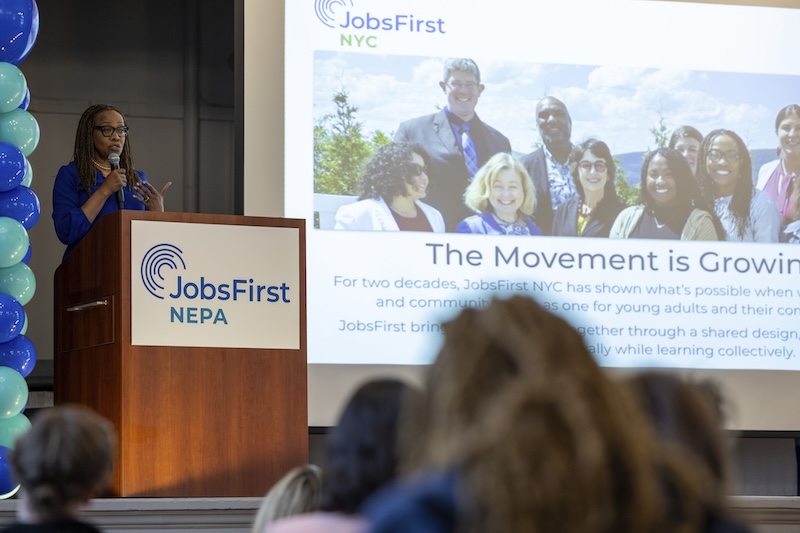
Marjorie highlighted that the vision for expansion to NEPA isn’t just a geographic shift, but a strategic scale of the Movement by Design approach. This framework focuses on:
- Building Infrastructure: Moving beyond simple collaboration to creating a permanent regional infrastructure that can sustain long-term change in other communities across the nation..
- Two Vehicles, One System: Launching both JobsFirst NEPA and the NEPA Workforce Funder Collaborative to align infrastructure and investment.
Dave Charron, Executive Vice President, JobsFirst and JobsFirst NYC, reflected on his two years working closely with the NEPA community and outlined what to expect as the organization moves to establish its presence in the region.
With an invitation to help address the needs of the more than 12,000 young adults in NEPA who are currently out of school and out of work, the partnership adapted the CommunityINC solutions framework and JobsFirst’s 5-step process, conducted deep research across local systems to identify challenges, and co-designed a roadmap to stand up JobsFirst NEPA as the core infrastructure support addressing root cause barriers to economic mobility for young adults and their communities.
A Regional Workforce Inflection Point
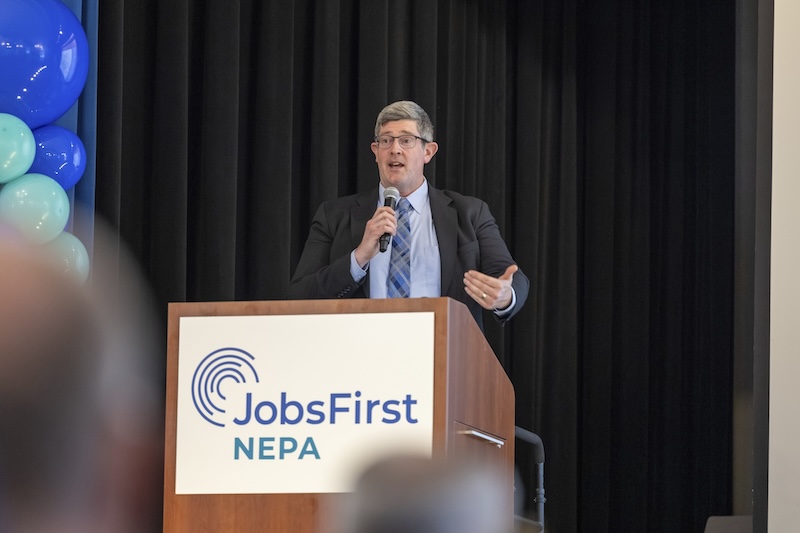
The launch of JobsFirst NEPA is backed by clear data and research. Teri Ooms, Founding CEO of The Institute, presented a compelling look at the Northeastern Pennsylvania workforce context, making it clear that the primary challenge facing the region is not job availability – it is access, preparation, and long-term sustainability.
Teri highlighted that the regional economy is anchored by industries with high demand but significant hurdles:
- Healthcare Shortages: Occupations like nurse aides, certified medical assistants, dental assistants, peer support specialists, and techs are critical, yet vacancies continue to impact both employer stability and community access to services..
- The “Middle-Skill” Gap: Across manufacturing, energy, and skilled trades, employers report persistent shortages driven by retirements, turnover, and a lack of candidates with technical credentials and “middle skills.”
- Applied Skills vs. Academic Pathways: While the region has strong education and training assets, fragmented systems create barriers to completion and employment. Many in-demand roles require hands-on, career-connected training and “applied skills” rather than traditional academic routes alone.

The Institute’s research underscores that workforce challenges are unevenly distributed. In post-industrial and rural communities, barriers such as transportation, childcare, language access, and complex system navigation remain the biggest hurdles to employment. Community organizations and place-based strategies are best positioned to ensure regional growth benefits those most impacted by economic change.
“The region has strong employers and hiring demand, but faces demographic change, uneven access to opportunity, and gaps between people, training, and jobs. Building a stronger workforce system requires alignment and shared responsibility across employers, educators, and community partners.”
Teri Ooms, Founding CEO, The Institute
The conclusion from the data is irrefutable: NEPA has opportunity, but opportunity must be intentionally connected to people. The region’s assets can no longer operate in silos—integrating work, education, and community is essential to long-term regional economic success. JobsFirst NEPA is designed to bridge these gaps, transforming fragmented efforts into a cohesive regional infrastructure that works for both the employer and the individual.
Moving the Needle on Economic Mobility
Shanie Mohamed returned to the stage to share how, as a neutral institution, JobsFirst NEPA brings diverse partnerships together through a collaborative change process to build transformative solutions focused on identifying challenges, incubating solutions, and advancing what works.
The data serves as a springboard for the work of the intermediary. The lack of awareness and understanding of local industries and opportunities creates challenges in retaining talent and setting young people on the right pathways for their success.
Intermediary efforts aim to impact out-of-school, out-of-work youth (16-24 years old), those who are in school but off track to graduate or without access to career-connected learning, the underemployed, and working-age individuals (24+) facing barriers and residents in high-need neighborhoods.
But how does it do that? Alongside the community partners, JobsFirst NEPA activates a five-step framework designed to move from listening, to standing up solution infrastructure, to long-term systemic change: Investigate, Imagine, Incubate, Implement, Integrate.
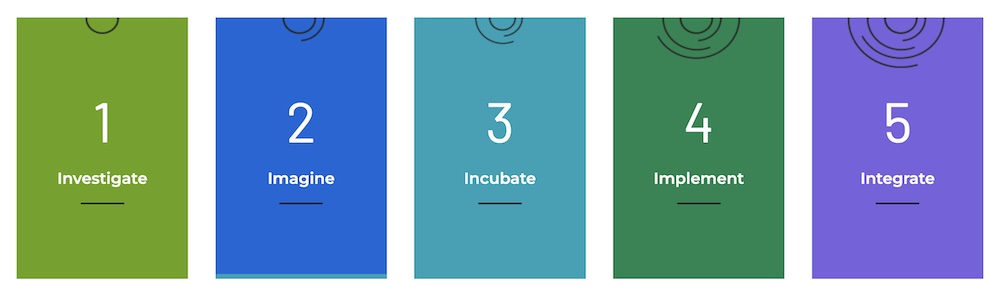
Together, through that process, partnerships will build solutions for emerging priorities across three key solution areas:
- Work Solutions: Advancing industry-specific pathways in high-demand sectors: Healthcare, Advanced Manufacturing and Energy
- Education Solutions: Career-connected learning; School-to-Work Pipeline; Apprenticeships and Internships
- Community Solutions: Place-based solutions that respond to the unique needs of communities
As echoed by all partners who made this all possible, the work is not meant to happen in a silo—it’s meant to be done with and alongside partners in the region. Aligning a region’s assets for the use of our young adults and their communities…What better way to move the needle on economic mobility?
To join the conversation and be a part of these growing collaborative efforts, visit jobsfirstnepa.org.